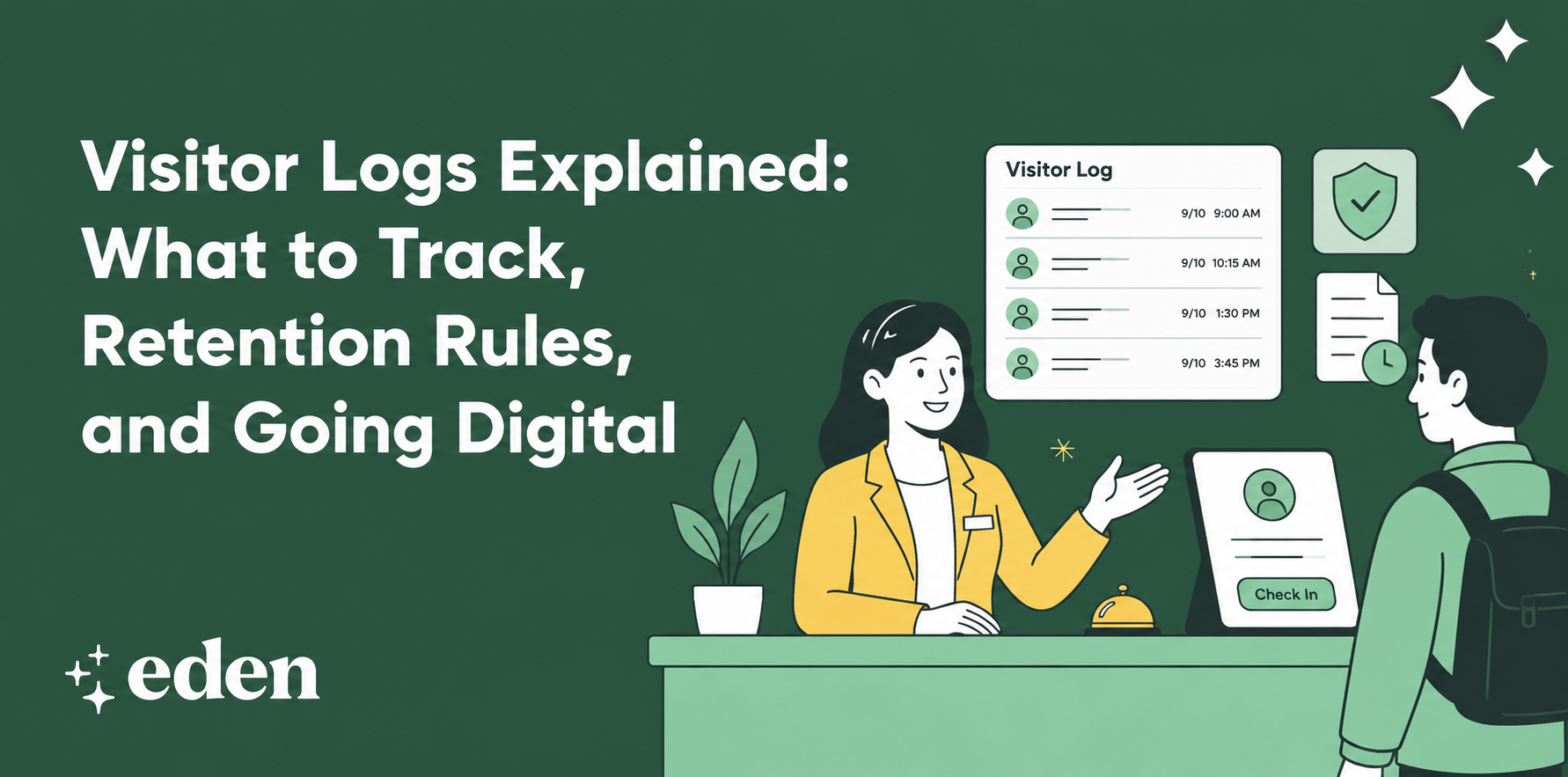
Visitor Logs Explained: What To Track, Retention Rules, and Going Digital
Key Takeaways
- A good visitor log balances two goals: capturing enough information to support safety and compliance, and protecting visitor privacy by not collecting or retaining more than necessary.
- Retention rules vary by industry and location, but the safest approach is a written policy with a clear timeline that's actually followed.
- Digital visitor logs solve the privacy and accuracy problems that come with a paper sign-in sheet at the front desk.
Flip open the sign-in book at almost any office front desk, and you'll see the same thing: a column of names, a column of companies, and a handwritten arrival time that's usually off by five minutes.
It works, sort of. But a visitor log does more than log a name. Done well, it's a safety tool, a compliance record, and a first impression, all in one clipboard.
Here's what actually belongs in one, how long to keep it, and why so many workplaces are retiring the paper version.
What Is a Visitor Log?
A visitor log is a record of who entered a workplace, when they arrived, who they were there to see, and when they left. Its original purpose was simple: know who's in the building.
That purpose hasn't changed, but the stakes around it have. A visitor log now often doubles as a security record, an emergency accountability tool, and, in regulated industries, a compliance document that must hold up if someone asks for it later.
What To Track in a Visitor Log
A useful visitor log doesn't need to be complicated.
At a minimum, it should capture:
- Full name and company or affiliation
- The employee or department the visitor is there to see
- Purpose of the visit
- Arrival and departure time
- A form of ID or badge issued for the visit
It's worth resisting the urge to collect more than that. Federal guidance on handling personal information recommends that businesses collect only what they need and dispose of it once it's no longer useful, which applies just as much to a visitor log as to a customer database.
Why Visitor Logs Matter for Safety, Not Just Records
The most overlooked reason to keep an accurate visitor log has nothing to do with paperwork. It's what happens during an emergency.
Workplace safety guidance calls for employers to account for everyone in the building after an evacuation, employees and visitors alike. A first responder can't do a headcount from memory, and a visitor who's never been in the building before is the person most likely to be unaccounted for if there's no record of them checking in.
Retention Rules: How Long Should You Keep Visitor Logs?
There's no single, universal retention rule for visitor logs. The general principle that shows up across most privacy frameworks is simpler than it sounds: keep the data only as long as you have a real reason to.
Data protection guidance describes this as holding records no longer than necessary for the purpose for which they were collected, then deleting or anonymizing them. That means a written retention policy matters more than a specific number of days.
Some regulations do spell out exact numbers. California's consumer privacy rules, for example, require certain request records to be kept for at least 24 months, which isn't a rule written specifically for visitor logs, but is a useful benchmark for any workplace team building a retention schedule from scratch.
Why Paper Sign-In Sheets Fall Short
A paper log has two structural problems. First, every visitor who signs in can see the name, company, and sometimes phone number of everyone who signed in before them. There's no way to keep that private on a single shared page.
Second, paper logs are nearly impossible to retire on schedule. A binder gets shoved in a drawer instead of being shredded, and a policy that says "keep records for one year" quietly turns into five years of unsecured paper sitting behind the front desk.
What Digital Visitor Logs Change
A digital visitor management system replaces the shared clipboard with individual, private check-ins. Each visitor enters their own information on a tablet or phone; hosts get notified automatically, and the record is stored and purged on a schedule rather than kept in a drawer.
The shift also tends to pay off in ways that go beyond privacy. Offices that make the switch report clear operational and safety gains, from faster check-ins to more accurate emergency headcounts, alongside a front desk experience that feels less like paperwork and more like a proper welcome.
FAQ
How Long Should a Business Keep Visitor Logs?
Long enough to serve a clear purpose, whether that's a security review window, an insurance requirement, or an industry regulation, and no longer. Most organizations set a timeframe between six months and two years in a written policy.
Do Visitor Logs Need To Include Personal Contact Information?
Only if there's a reason for it: a name, company, host, and visit time cover most needs. Phone numbers or emails should be collected only if there's a specific use for them, such as sending a digital badge or a follow-up notice.
Is a Digital Visitor Log More Secure Than a Paper One?
Generally, yes. Digital systems keep each visitor's information private from other visitors and make it far easier to enforce a retention schedule, rather than letting old records pile up.
The Bottom Line
A visitor log is a small piece of office infrastructure that carries more weight than it should. Track the essentials, set a retention policy and stick to it, and treat visitor data with the same care as any other personal information moving through the building.
Moving that process to a connected workplace platform makes all three of those things easier to maintain consistency, without adding more work at the front desk.
Sources:
Protecting Personal Information: A Guide for Business | Federal Trade Commission
Principle (e): Storage Limitation | Information Commissioner's Office
11 CCR § 7101 — Record-Keeping | Cornell Law School Legal Information Institute